Showing posts with label Reading. Show all posts

Monday, July 4, 2022

Stella Diaz

Students enjoyed our PARP book this year: Stella Diaz has Something to Say.  This book is written by Angela Dominguez  Our PTA purchased a book for each student in the school and we have been reading it together as part of our program: One Book One School!


We love this book because it highlights diversity.  Stella is unique because she can speak both Spanish and English.  Students love learning some new Spanish words throughout each chapter.

Each day we read a chapter and complete a short activity about the book.  Below, students worked on teams to create posters for their favorite parts of the book.


In celebration, we had a fun flashlight reading day and began using our Neon Reading kits for close reading.  Students highlight the words and mark up the text.  Then they use their black light flashlights to light up the most important words and phrases.


Reading is one of our favorite subjects in fourth grade.  What do you do for fun?

Sunday, July 31, 2016

Prepare Your Classroom for the 2016 Presidential Election

Is your classroom prepared for the 2016 Presidential Election?


Bundle and Save with my 2016 Presidential Election Bundle.

This is a combination of 2 of my hot Election packs:

- Hillary Clinton vs. Donald Trump
- Election Vocabulary Posters and Activities.

With these packs, you will get an article and paired passages to compare and contrast background information and viewpoints on various issues for both Hillary Clinton and Donald Trump.


Students are also provided with graphic organizers and final copy paper to create and display persuasive letters as to which candidate they most support.


Print the vibrant posters in color or black and white to create a classroom display or word wall of all the important election vocabulary.


Provide students with mini dictionaries to keep track of all their new Election vocabulary words.

Use the playing cards for a quick matching game like Memory or glue them back to back to make flash cards for study.


Further practice these new Election vocabulary words with a matching worksheet, word search, and 4-square organizers.


Create trading cards for both Hillary Clinton and Donald Trump.


Save 20% off individual pricing when you purchase the bundle!


How will you prepare your classroom for the 2016 Presidential Election?

Friday, July 10, 2015

The Daily 5 Book Study - Chapter 4

Before you begin The Daily 5 there are a few items that you will need to gather.


Check out what you need to begin The Daily 5:


1.  Quiet Signal
The 2 sisters mention using chimes for your quiet signal.  Whatever you choose, save your voice, and find something that makes a unique sound in comparison to the quiet hum of student voices.  You want something that will stand out and grasp student attention quickly.

After you use your signal it is important to pause for a moment.  Don't hit the chime again, don't talk, don't move....just wait for students to recognize that you need their attention.

Once you have gained all students' attention, give the directions in a quiet voice to force students to focus and really listen to what you are trying to say.

2.  Chart Paper to Display
Although I have a Smart Board in my classroom I still love to use chart paper.  It is fun to write on and can be displayed throughout the classroom for all to see.  Chart paper can be used for your i-Charts and as a reference for students throughout the school year.

3.  Tools, Not Toys
Do you have students who are easily distracted and need a little more support?  Gather some tools, not toys, for them to use.

These tools could be stop watches, timers, whisper phones, manipulatives, highlighting tape, post-its, or even a special carpet square or "office" set up throughout the classroom to help them stay in one place.

4.  Book Boxes & a Well Stocked Classroom Library
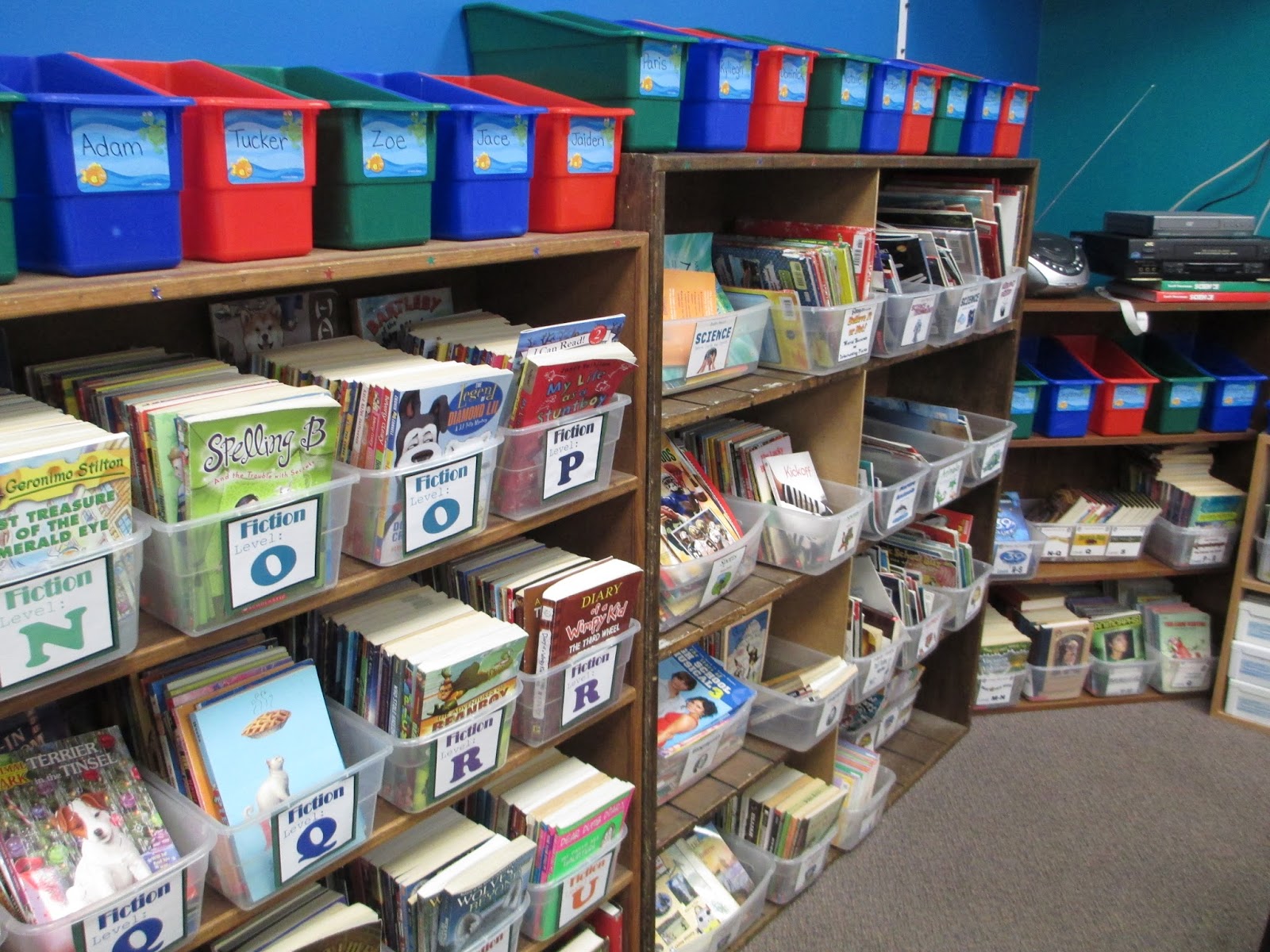
To me, this is by far the most important item needed for The Daily 5.  Teachers should provide students with book bins to hold the books that they are currently reading, as well as a well stocked library.

I purchased my book bins from Really Good Stuff 7 years ago and they are still in great shape.  It is one of the best investments that I have made.


My classroom library consists of over 2,000 books.  Each year it grows bigger.  I collect books from garage sales, book sales, donations, Scholastic, and Donors Choose.  I also love to bring in books from the school and public libraries so that there are always new selections for students to browse.


5.  Gathering Place
I've noticed that in teaching upper elementary this is the one part of the classroom that many teachers ignore.  Teaching while students sit on the carpet is often considered very "primary."  However, it is a key component to my teaching.  I love to set up the classroom so that it looks roomy and so that we have a huge sport for students to sit and gather in front of the Smart Board.  Transitioning to our gathering spot provides students with a quick movement break.  Sitting knee to knee with our peers encourages easy communication during think-pair-shares.  The close proximity to me provides me with easy access to assess students thinking and to move around and contribute to their discussions.  Plus, there are very little distractions on the carpet.  No papers, crayons, and scissors to mess with, no chairs to lean back in, and no desks to wiggle.


6.  i-Charts
Creating these simple anchor charts and permanently displaying the charts of collective class learning is valuable when teaching students the routines for The Daily 5.  An i-Chart is simply a t-chart.  On one side you record what students are suppose to be doing during a specific rotation of the Daily 5 and the other side is what the teacher is suppose to be doing.

7.  Effective Classroom Design
I like to organize my classroom with students desks in groups to maximize peer to peer communication and collaboration.  Clustering desks in this manner also maximizes the rest of the space within the classroom.


You can also provide alternative places for students to sit such as on pillows, bean bags, couches, carpet squares, lowered tables to kneel next to, and standing room next to cleared counters.

What else do you use for The Daily 5?

Friday, July 3, 2015

Daily 5 Book Study - Chapters 2 and 3

This week I have a little catching up to do so I am going to combine my post about The Daily 5 chapters 2 and 3.

Chapter 2 outlines the core beliefs of The Daily 5.  Chapter 3 focuses on the seventh belief, 10 Steps to Independence.  


Here are my major "take aways" from each section:

Trust & Respect
In order for meaningful learning to occur the teacher must first build trust and respect in the classroom.  Taking time to build this is the foundation upon which all the elements of The Daily 5 are built.

Community
Take the time to develop a healthy, safe, and fun classroom community.  A sense of community empowers students to hold each other accountable.

Choice
Providing students with choice is not only motivating but allows students to take ownership and responsibility for their learning.

Accountability
Teach students to be accountable for their learning and meaningfully independent.

Brain Research
The Daily 5 is firmly grounded in solid brain research.  I love the graph on page 31 that displays how the amount of time a student reads daily influences achievement.

It is amazing how an extra 10 minutes of reading per day can increase the amount of words students encounter by over 1 million words per year.  Yes, one million!  Crazy!

Transitions as Brain & Body Breaks
The Daily 5 consists of a short focus lesson followed by short work sessions that are split up with short bursts of movement and instruction.  By providing students with necessary breaks you reduce the amount of distracting behaviors that often pop up during longer work sessions.

10 Steps to Independence
Chapter 3 focuses on the seventh belief, the 10 Steps to Teaching & Learning Independence. 


By taking the time to explicitly teach, model, practice, and reflect on student independence, students will begin to build their stamina and establish the desired default Daily 5 behaviors.  This frees up the teacher to teach!

What beliefs and principals influence your teaching?

How do you teach independence?

Check out Adventures of Room 129, to learn more about chapter 2 and The Crazy School Teacher's blog to learn more about chapter 3.

Thursday, July 2, 2015

Before Summer Book Exchange

Would you like to motivate students to read over the summer?

Do you hope to share a love of books?

How do you help students beat the summer slide?

Try a book exchange!


A few weeks before summer begins I send a letter home asking students and families to donate lightly used, age appropriate, books and magazines to our class book exchange.

I raid our classroom library for well loved books, or extra copies that we no longer need to add to the pile of donations.  I use bonus points to purchase new Scholastic Reading Club dollar deals.

Once we have collected enough books, I spread them out on all the desks and tables around the classroom.


I purchase summer beach bags from the Dollar Tree for each student to use.  As they selected "new" books students stored them in their bags.


I have students line up and move around the desks and tables clockwise and in order.  In the beginning, students select one book per rotation.  This prevents any pushing or shoving and helps make sure that everyone gets an equal chance to select the books they like.


By the end or our book exchange student bags are overflowing with great summer reads.


This is the second year that I have held a book exchange and students loved it!


How do you encourage students to read over the summer?

Sunday, February 1, 2015

How to Use Mom Made Us Write This in the Summer & GIVEAWAY!

I'm very excited to share with you how we have been using Ali Maier's book, Mom Made Us Write This in the Summer, throughout the last few weeks of school.  As you may remember, I first mentioned this book right before Christmas break.  This book is about twins, Maggie and Max, who are challenged by their mom to write 12 journal entries together during the Summer.  The twins analyze a different event, situation, or activity for each chapter (or journal entry) which makes for a great book to focus on analyzing, comparing, or contrasting perspectives.  You can read my initial review here.


Here are my suggestions for using the book in your classroom:

Ways to Read in the Classroom:
- Provide individual copies for students to read independently.
- Read with a partner (one student reads Maggie's part while the other reads Max's.)
- Read whole class (teacher reads main text and chooses a student to read Maggie's comments and another to read Max's.)
- Project for the class to see so they can follow along with all Maggie and Max's commentary.


Using the Book to Teach Comprehension Strategies:
- Analyze characters and setting.
- Locate humor and descriptive details within the text.
- Create a list of Maggie and Max's character traits.


Initially, I recorded every student suggestion.  Then, students looked back, and debated whether or not each character trait really fit the characters.  If not, we crossed them out, and added a better fitting trait.

- Analyze perspectives.
- Compare and contrast Maggie and Max's experiences, perspectives, likes, and dislikes


Below, students compared and contrasted Maggie and Max's experiences at a hotel.


Journal Writing
- Analyze the genre of journal writing.
- Use this book as an anchor text to model positive characteristics of good journal writing.
- Use this book to launch an in-class journal writing center where students write back and forth to one another in the same fashion as Maggie and Max.
- Launch an at-home journal writing activity over an extended break (Christmas, February, April, Summer, etc...)

Want to snag a copy of this book for your classroom?  Enter using Rafflecopter below.

a Rafflecopter giveaway

Lastly, be sure to check out Ali Maier's website for more resources and information!

Sunday, December 14, 2014

Mom Made Us Write This in the Summer REVIEW

I am always on the look out of new books to share with my fourth graders so you can imagine my delight when I was invited to review a copy of Ali Maier's Mom Made Us Write This in the Summer.

 I dove into reading the second this book arrived (for free) at my doorstep.  It didn't take long to realize that this book would be a huge hit with my students.

So what is it about?  A sister and brother (twins) are forced by their mother to write in a journal together over the summer.  There are 12 entries and each twin takes a turn writing their perspective of a specific event or topic as well as commenting on their sibling's entry.  The font for the twins, Maggie & Max, stand out so you can easily tell who is writing.  Maggie's is lighter, my "girlie" and has dots the letter i with a heart.  Max's font is bolder and more masculine. 
 
My students immediately fell in love with Max's sense of humor and Maggie's quick wits. Both are lovable characters who hook you into the storyline.
This book lends itself well for introducing journal writing to your class, as well as analyzing perspectives.  There is an amazing website that accompanies the book (and future books) containing helpful links, resources, and fun stuff for children, adults, parents, and teachers.

I began reading this book with my class last week and can't wait to complete it before Christmas break.

Check back in a few weeks to see how I use this amazing book in my classroom and for a chance to win a copy for yourself!

Monday, June 30, 2014

Reading in the Wild - Chapter 1

What is on your summer reading list?

One of my top reading picks this summer is Donalyn Miller's: Reading in the Wild.  Have you read her other book, The Book Whisperer?  If you liked it this is the perfect book for you!

I was inspired to read this book when I noticed Catherine, The Brown Bag Teacher's, book study.


Catherine's split Chapter 1 up into two weekly posts but I'm a little late to the party so I am going to combine both together so that I am all caught up.


Chapter 1 focuses on dedicating time to read.  Not just in the classroom, but at home as well.

As teachers, we experience many road blocks that prevent us from our own free reading, so it is only fair to assume the same for our students.  Personally, my biggest road block is a lack of time and energy.  I purposefully wait for extended breaks from school, or a random snow day, to squeeze in a good book.  I need to be more intentional in my search to find extra reading "moments"....while waiting at the doctor's office, riding (as a passenger) in the car, sitting on the toilet...you get the idea.  The key is to remember to bring a book with you....EVERYWHERE!!!

To make this point clear, I am going to have students start storing their book bins under their desks rather than on top of the bookshelf.  Students use book bins to store their books.  I use to have students get up to get their book bin at the start of independent reading, and then I'd require them to put it back at the end of our 20-30 minutes of reading.  However, this year I plan on having students bring their book bin to their desk immediately upon arriving in school and then keeping it with them until it is time to clean up for dismissal.  That way, if students complete their work early or have a few extra moments they can squeeze in some extra reading.


I will also stress the importance of bringing a book with them to lunch, on the bus, while waiting in line to use the restroom, etc...  My hope in implementing this in our classroom, will be that they will carry it over when they go home..

Alyssa, from Fourth Grade Racers, posted about using Wordle.  I love making word clouds.  We used ABCYA to create word clouds with key science vocabulary this year and then ironed our designs on to t-shirts.  I think I may kick start independent reading with the creation of a word cloud containing a student generated list of when we can squeeze in extra reading time.  This can be blown up into a poster and displayed in the classroom to refer back to or shrunk down and turned into bookmarks for each students to have as a nifty reminder.
Our district requires that students read for 20 minutes each night.  We currently encourage our reading school-to-home connection with various activities...


Chapter one mentions the importance of providing students with as much time as possible to read in class, in-case they can not squeeze in enough time at home.  After all, we can not control what goes on in their home life like we can in our classroom.  Which brings me to my Language Arts block.

This upcoming school year our principal has created our schedule for us.  We are being given 1 hour for Engage NY's ELA modules and another hour for independent reading, centers, and guided reading.  Here is what my schedule might look like on a typical day:


ELA Module - This year, our school will be using Engage NY's ELA Modules.  The module lessons take about 1 hour to complete and integrate science and social studies content with reading and writing.  They contain high level texts, close reading activities, writing about reading, collaborative learning, and much more.  They are free for anyone to use and you can check them out and download all the lessons and resources here.

Reading Block - I try my hardest to group students into 3 reading groups based on reading level and skill.  My groupings change frequently throughout the year as students progress levels and change in strengths and needs.  With 3 reading groups come 3 center rotations that each last about 20 minutes.  Students meet with me for a guided reading lesson, they read independently and/or respond to text in writing, and complete a third center.  The third center is either a word work activity, a writing activity (often the homework from that day's module lesson since our district has decided not to send it home) or RAZ Kids on the computer or Kindle.  I love RAZ Kids because it provides students with choice in text, assesses their comprehension (and sends me reports), and rewards students for their efforts.  RAZ Kids can also be used at home which expands the amount of on-level texts available to students outside of school.

Chapter 1 suggests that you use 1/3 of your reading block for independent reading.  If you ignore the module time, we will be right on target!!!

Chapter 1 also mentions the importance of conferencing with students.  I hope to integrate that somewhere into our schedule.  I know most teachers are not given 2 hours for Language Arts, however, I always feel that no amount of time is ever enough.

Check out all the other posts about chapter 1 and link up with your ideas.