Friday, July 10, 2015

The Daily 5 Book Study - Chapter 4

Before you begin The Daily 5 there are a few items that you will need to gather.


Check out what you need to begin The Daily 5:


1.  Quiet Signal
The 2 sisters mention using chimes for your quiet signal.  Whatever you choose, save your voice, and find something that makes a unique sound in comparison to the quiet hum of student voices.  You want something that will stand out and grasp student attention quickly.

After you use your signal it is important to pause for a moment.  Don't hit the chime again, don't talk, don't move....just wait for students to recognize that you need their attention.

Once you have gained all students' attention, give the directions in a quiet voice to force students to focus and really listen to what you are trying to say.

2.  Chart Paper to Display
Although I have a Smart Board in my classroom I still love to use chart paper.  It is fun to write on and can be displayed throughout the classroom for all to see.  Chart paper can be used for your i-Charts and as a reference for students throughout the school year.

3.  Tools, Not Toys
Do you have students who are easily distracted and need a little more support?  Gather some tools, not toys, for them to use.

These tools could be stop watches, timers, whisper phones, manipulatives, highlighting tape, post-its, or even a special carpet square or "office" set up throughout the classroom to help them stay in one place.

4.  Book Boxes & a Well Stocked Classroom Library
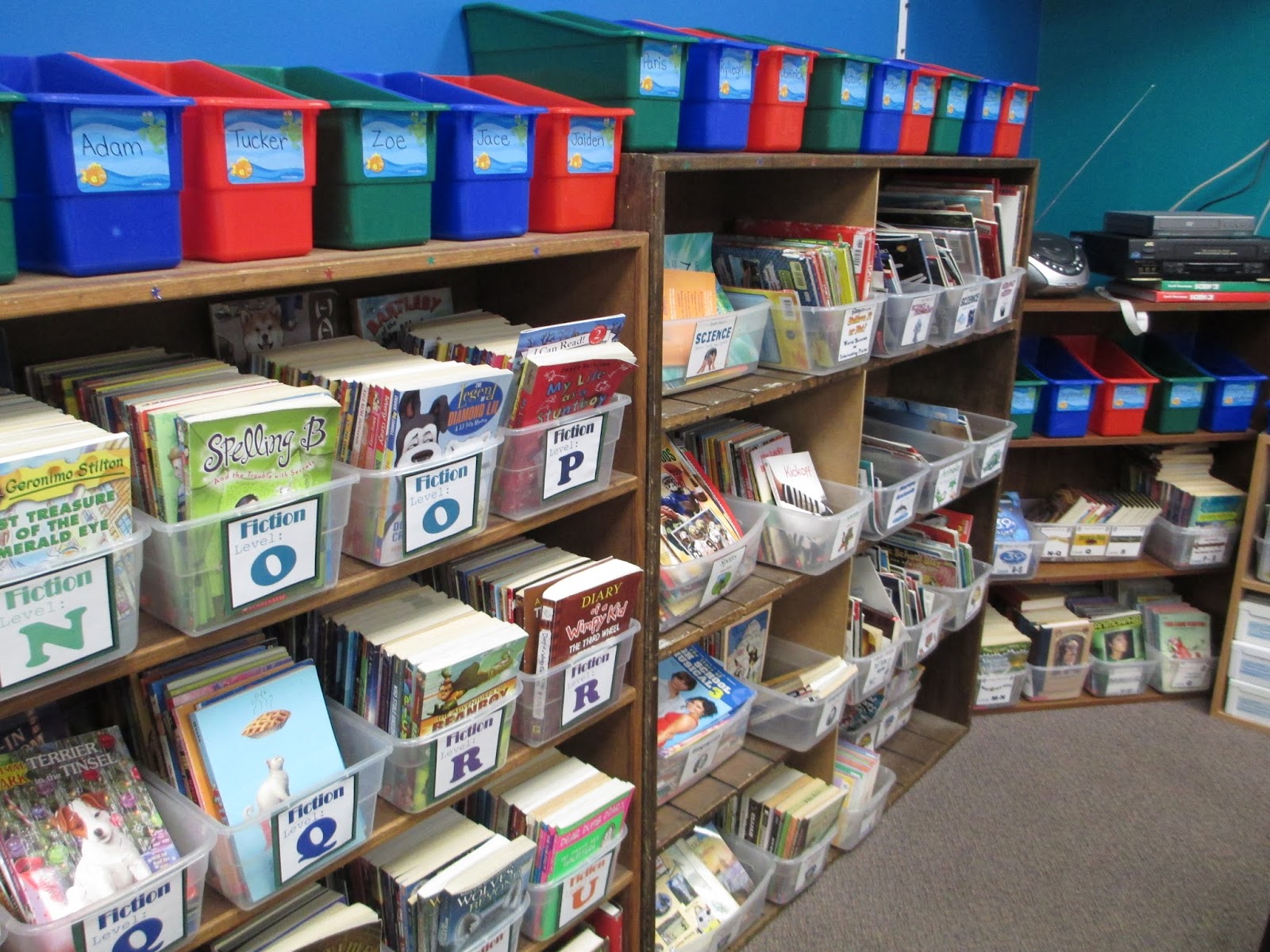
To me, this is by far the most important item needed for The Daily 5.  Teachers should provide students with book bins to hold the books that they are currently reading, as well as a well stocked library.

I purchased my book bins from Really Good Stuff 7 years ago and they are still in great shape.  It is one of the best investments that I have made.


My classroom library consists of over 2,000 books.  Each year it grows bigger.  I collect books from garage sales, book sales, donations, Scholastic, and Donors Choose.  I also love to bring in books from the school and public libraries so that there are always new selections for students to browse.

5.  Gathering Place
I've noticed that in teaching upper elementary this is the one part of the classroom that many teachers ignore.  Teaching while students sit on the carpet is often considered very "primary."  However, it is a key component to my teaching.  I love to set up the classroom so that it looks roomy and so that we have a huge sport for students to sit and gather in front of the Smart Board.  Transitioning to our gathering spot provides students with a quick movement break.  Sitting knee to knee with our peers encourages easy communication during think-pair-shares.  The close proximity to me provides me with easy access to assess students thinking and to move around and contribute to their discussions.  Plus, there are very little distractions on the carpet.  No papers, crayons, and scissors to mess with, no chairs to lean back in, and no desks to wiggle.


6.  i-Charts
Creating these simple anchor charts and permanently displaying the charts of collective class learning is valuable when teaching students the routines for The Daily 5.  An i-Chart is simply a t-chart.  On one side you record what students are suppose to be doing during a specific rotation of the Daily 5 and the other side is what the teacher is suppose to be doing.

7.  Effective Classroom Design
I like to organize my classroom with students desks in groups to maximize peer to peer communication and collaboration.  Clustering desks in this manner also maximizes the rest of the space within the classroom.


You can also provide alternative places for students to sit such as on pillows, bean bags, couches, carpet squares, lowered tables to kneel next to, and standing room next to cleared counters.

What else do you use for The Daily 5?

Thursday, July 9, 2015

The Business Side

Each day I anxiously await the arrival of our mailman in hopes that he has a special package with my name on it.

However, more recently, I have been waiting for a package with a different name....my business name, Elementary School Garden.

That is because I have recently decided to turn my little blog, Teachers Pay Teachers Store, and everything in between into a small business.  An S Corp to be exact.

What is an S Corp you ask?

An S Corp, also referred to as S Corporation, is a special type of corporation created through an IRS tax election.

Why would I want to be an S Corp?

Simply put, to avoid double taxation.

How do you pay taxes for your Teachers Pay Teachers earnings?
What expenses can you deduct?
What kind of paperwork do you need to complete?
How did you become a corporation?
Do you have a business plan?
How did you design your blog?
How do you know what to blog about?
How do you upload products to Teachers Pay Teachers?
Dare I say C-C-C-Copyright?????
How do you advertise?
What about social media?

Ah, so many questions.

Every day I receive questions from loyal followers and new Teachers Pay Teachers sellers in regards to the business side and that is why I have decided to devote a little time each week to answer some of the business questions that come along with working as a teacher, maintain a household, and raising a family, all while running a small business, such as selling products on Teachers Pay Teachers.


Tune in every Thursday to hear about the business side of Elementary School Garden.

I am by no means an expert, but join me on this crazy journey, and we can learn from each other.

Have a question about selling on Teachers Pay Teachers, blogging, or running a small business?  Comment below and I will try to answer all of your questions over the next few weeks!

Friday, July 3, 2015

Daily 5 Book Study - Chapters 2 and 3

This week I have a little catching up to do so I am going to combine my post about The Daily 5 chapters 2 and 3.

Chapter 2 outlines the core beliefs of The Daily 5.  Chapter 3 focuses on the seventh belief, 10 Steps to Independence.  


Here are my major "take aways" from each section:

Trust & Respect
In order for meaningful learning to occur the teacher must first build trust and respect in the classroom.  Taking time to build this is the foundation upon which all the elements of The Daily 5 are built.

Community
Take the time to develop a healthy, safe, and fun classroom community.  A sense of community empowers students to hold each other accountable.

Choice
Providing students with choice is not only motivating but allows students to take ownership and responsibility for their learning.

Accountability
Teach students to be accountable for their learning and meaningfully independent.

Brain Research
The Daily 5 is firmly grounded in solid brain research.  I love the graph on page 31 that displays how the amount of time a student reads daily influences achievement.

It is amazing how an extra 10 minutes of reading per day can increase the amount of words students encounter by over 1 million words per year.  Yes, one million!  Crazy!

Transitions as Brain & Body Breaks
The Daily 5 consists of a short focus lesson followed by short work sessions that are split up with short bursts of movement and instruction.  By providing students with necessary breaks you reduce the amount of distracting behaviors that often pop up during longer work sessions.

10 Steps to Independence
Chapter 3 focuses on the seventh belief, the 10 Steps to Teaching & Learning Independence. 


By taking the time to explicitly teach, model, practice, and reflect on student independence, students will begin to build their stamina and establish the desired default Daily 5 behaviors.  This frees up the teacher to teach!

What beliefs and principals influence your teaching?

How do you teach independence?

Check out Adventures of Room 129, to learn more about chapter 2 and The Crazy School Teacher's blog to learn more about chapter 3.

Thursday, July 2, 2015

Before Summer Book Exchange

Would you like to motivate students to read over the summer?

Do you hope to share a love of books?

How do you help students beat the summer slide?

Try a book exchange!


A few weeks before summer begins I send a letter home asking students and families to donate lightly used, age appropriate, books and magazines to our class book exchange.

I raid our classroom library for well loved books, or extra copies that we no longer need to add to the pile of donations.  I use bonus points to purchase new Scholastic Reading Club dollar deals.

Once we have collected enough books, I spread them out on all the desks and tables around the classroom.


I purchase summer beach bags from the Dollar Tree for each student to use.  As they selected "new" books students stored them in their bags.


I have students line up and move around the desks and tables clockwise and in order.  In the beginning, students select one book per rotation.  This prevents any pushing or shoving and helps make sure that everyone gets an equal chance to select the books they like.


By the end or our book exchange student bags are overflowing with great summer reads.


This is the second year that I have held a book exchange and students loved it!


How do you encourage students to read over the summer?

Thursday, June 25, 2015

Daily 5 Book Study - Chapter 1

It has been a while since I last read, The Daily 5, by the 3 Sisters, and there is a new edition out.  I borrowed an old copy from a teacher friend to scan as a refresher while I waited for the new edition to arrive in the mail compliments of the fast and furious Amazon Prime 2-day shipping!  It should arrive just in the nick of time for me to participate with some other fabulous bloggers in a little summer book study.

This week, Primary Inspired is hosting the book study with a focus on Chapter 1:  How Daily 5 Has Evolved.

What is the Daily 5 you ask?

The Daily 5 is a framework for structuring literacy time so students develop lifelong habits of reading, writing, and working independently.

Students work though activities such as:

- Reading to Self
- Reading with a Partner
- Writing about Reading
- Listening to Reading
- Word Work and Spelling

These activities are completed independently by students providing the teacher with time to confer with individuals or to pull small groups for reading instruction.

The second edition of The Daily 5 places an emphasis on flexibility.  This is not a one size fits all program.  Students do not have to move through all 5 rounds of the Daily 5 in one day.  You are the teacher, and you know what works best for your individual students, so do what you know is best.

While reading chapter 1 I immediately think of how we integrated Engage NY's ELA Modules into our ELA block this year.  

We spent the first hour of our ELA block working through a module lesson.  The second hour was spent on reading centers and guided reading.  We did not complete all 5 rounds of the Daily 5.  There was simply not enough time.  What was important is that students were actively involved in reading, writing, and working independently during the second half of our ELA block which provided me with valuable teacher time to work with small groups on individual needs.


I will admit, during my first few years of teaching I had students complete a lot of "busy" work during reading centers.  I had them creating book reports, completing projects, playing games, and doing all kinds of "cute" things?  Did they learn?  Yes!  Was there a lot of prep work?  Yes!  Did it waste a lot of time?  Yes!  Was it really worth it?  No!  Not when you can get a bigger bang for your buck using a structure like Daily 5.  Hey, you live you learn!

Have you tried Daily 5 in your classroom?  If you have, I'd love to hear how it works in your classroom?

Check back soon!  I will be posting about my thoughts on chapter 2.

Monday, June 15, 2015

Sensory Bin for Monday Made It

Over the weekend, Natalie and I gathered supplies to create our first sensory bin of the summer.  I plan on making a few of these over our vacation together.  Sensory bins serve has a great tactile tool for toddlers and primary students to explore and develop basic life skills, fine motor skills, language, and more.


I snagged a storage bin from Walmart, a few bags of beans, sand box toys, little plastic dinosaurs, measuring cups and spoons from the Dollar Tree.


Natalie had a ball practicing digging, scooping, and pouring while we talked about burying and locating the rainbow assortment of dinosaur friends..


The whole bin was created for around $10.


Check out all the other Monday Made It's at Tara's blog, Fourth Grade Frolics.

Sunday, June 14, 2015

ATB Challenge - Week 10

Welcome back blogging buddies for week 10 of our ATB Challenge!  Sorry for the delay in posting!


Here is your Week 10 Challenge: 


If you have made it through all 10 weeks of the ATB challenge it is finally time to treat yourself.

The first thing that comes to mind when I hear, "Treat Yourself," is ice cream, pizza, candy, dessert.

However, you don't have to treat yourself with food.

You can treat yourself with free time, a nice walk, a bubble bath, additional reading time to read something of YOUR choice, a car wash, a pedicure, a stay in your pajama day, etc....


Reward yourself when you accomplish your goals, cross of items on your to-do list, and when you simply need a break.


So, how do you plan to treat yourself this week?

Check out all 10 challenges here.